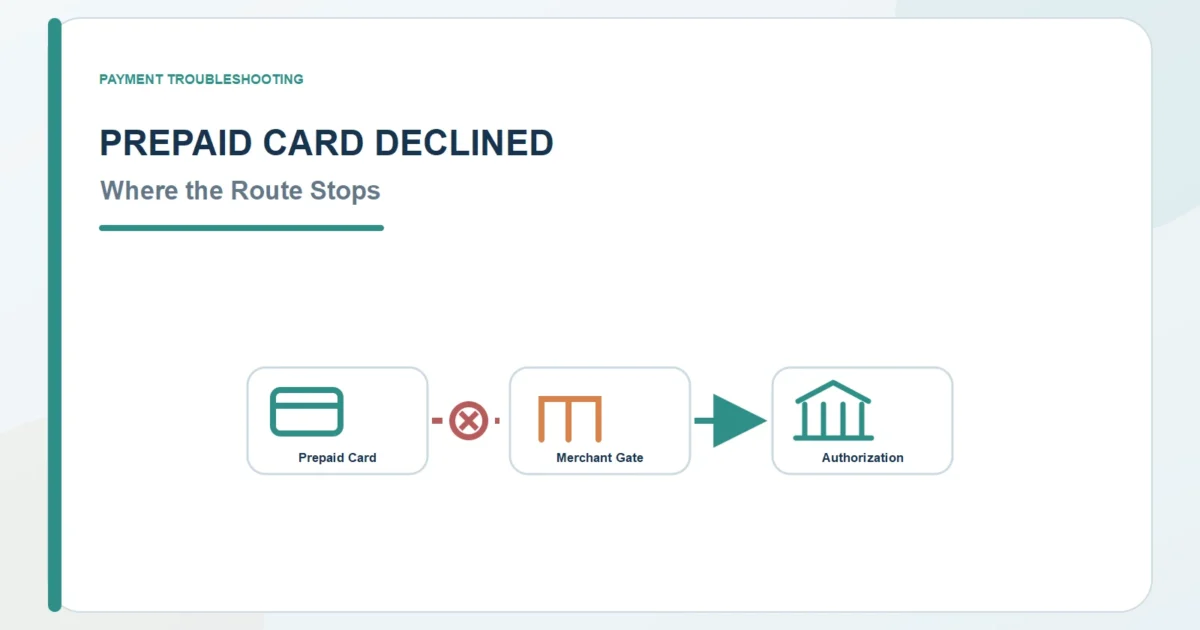
Prepaid Program Gate
Prepaid Visa Declined Online? Why It Works Once but Fails Later
A prepaid card can be active, registered, funded, and proven by a previous purchase—and still fail on the next one. The second transaction may ask for a capability the first never needed: future merchant charges, a larger authorization hold, foreign use, address verification, a different card profile, or a later deposit. This guide finds that new requirement.
First Read
Ask What This Transaction Needs That the Last One Did Not
Do not start with “the card worked before.” Compare the two payment jobs. A one-time purchase may need only an active card and enough balance. A subscription, trial, hotel, foreign merchant, or deposit can add recurring authorization, profile checks, international use, extra held funds, or merchant card-type restrictions. The prepaid program must support the new job.
Program Capability Map
One Prepaid Card, Several Different Capability Tests
Visa or Mastercard branding gives the card a network route, not a universal feature set. The prepaid program decides what the card can do; the merchant decides whether that exact prepaid profile fits the purchase. The table compares the extra capability each failed transaction may be asking for.
| New Capability or Symptom | What Changed From the Simpler Purchase | Evidence to Compare |
|---|---|---|
| Works once, then renewal fails | The second charge needs a reusable recurring route: the merchant must keep a valid billing agreement and the prepaid program must allow later merchant-initiated authorization | Compare the first and renewal dates, merchant descriptor, card expiry, registration, future balance, recurring support, backup-method rules, country, currency, merchant card-profile policy, and issuer or program message |
| Free trial rejects the card | The trial may ask for both an initial verification and a card route that can support the later paid conversion, sometimes with a temporary hold or backup-method requirement | Record the trial end date, full future price, temporary authorization, prepaid-program recurring capability, billing profile, available balance, card expiry, backup-method rule, merchant policy, and cancellation deadline |
| Online checkout needs a registered profile | The previous purchase may not have required the same address, identity, online-use, or profile check; this merchant may compare billing details or require features available only after activation or registration | Check activation, registration, identity verification, cardholder name, genuine billing address, postal code, card country, online-use status, and the merchant’s profile requirements |
| The visible price fits, but the authorization does not | This transaction asks the prepaid balance to cover the full authorization, which can include tax, conversion, deposit, tip, pending amounts, or a temporary hold above the displayed price | Compare the current available balance with the authorization amount, pending holds, taxes, fees, conversion, deposit, tip, card limits, and merchant release timing |
| Works locally, fails on a foreign website | The new transaction adds a foreign merchant, currency, card-not-present route, merchant category, or cross-border risk that the prepaid program or merchant may restrict | Check program international-use terms, merchant and card countries, billing currency, conversion, online-use status, merchant category, recurring requirement, billing profile, and merchant prepaid-card policy |
| The merchant rejects the prepaid card profile | The network can be supported while prepaid, reloadable, foreign-issued, unregistered, or certain program profiles are excluded for this product or transaction | Read the live checkout and merchant policy; compare the exact prepaid program, network, card country, product, deposit or hold, subscription or trial, and whether another prepaid program would be treated differently |
| The card program does not support the required online flow | The merchant may require online card-not-present use, authentication, recurring billing, refunds, partial capture, a deposit, or another capability that this program does not provide | Check the program agreement, online and recurring settings, EMV 3-D Secure or other authentication support, card status, refund behavior, authorization-hold support, and the exact merchant flow |
| The merchant, processor, or issuer risk decision changes | The same prepaid card can receive a different result when the merchant, device, country, amount, descriptor, retry pattern, or card profile changes | Save the exact decline message, merchant descriptor, amount, device or browser, timestamps, repeated attempts, issuer or program alerts, account status, and whether the merchant created an order or hold |
Route Preflight
Read the Merchant Order and Prepaid Card State Before You Retry
Start with the last successful use and this failed one. Compare merchant, amount, country, currency, transaction type, recurring or trial requirement, deposit or hold, billing profile, and card-program status. The difference usually reveals which capability the new transaction needs.
1. Check Program State Before Balance
Confirm the exact prepaid program is active, activated, registered, verified where required, unexpired, and enabled for online use. A sufficient balance cannot compensate for a program or card status that does not allow this transaction.
2. Compare the Price With the Full Authorization
Compare the visible price with the actual authorization request and current available balance. Include tax, currency conversion, fees, tips, deposits, pending amounts, and temporary holds. The failed transaction may simply require more available funds than the earlier one.
3. Ask Whether the Card Must Work Again Later
Subscriptions, free trials, delayed capture, deposits, and some bookings need a credential that survives beyond the first authorization. Check recurring support, future balance, expiry, backup-method requirements, merchant-initiated charges, and whether the prepaid program allows the later billing event.
4. Check Whether This Merchant Needs a Stronger Profile
This merchant may require registration, a billing address, postal-code support, identity verification, a matching card country, or a card profile it accepts. Use the genuine provider record and merchant requirements; do not invent local details to make the route appear eligible.
5. Check Whether the Failed Purchase Crosses a New Country or Currency
If the earlier purchase was domestic and this one is foreign, check the program’s international online-use rules, merchant country, billing currency, conversion, merchant category, card country, recurring or hold requirements, and any cross-border restriction. The network logo does not make every prepaid program international.
6. Stop Before Creating a Second Authorization
Confirm whether the failed prepaid attempt is declined, pending, completed, reversed, or tied to a merchant order or hold. Another card, PayPal, wallet, gift-card balance, or bank transfer starts a new route and can create a duplicate order or authorization; it does not repair the first attempt.
Capability by Job
What Extra Ability Does This Purchase Require?
A one-time purchase, subscription, free trial, app-store purchase, gaming transaction, travel booking, and international checkout can ask for different card-program abilities. Compare the job before assuming the card itself changed.
| Payment Job | Extra Capability Needed | What to Compare |
|---|---|---|
| One-time online purchase | Active online card use plus enough balance for one authorization | Program status, registration if required, full authorization amount, billing profile, merchant prepaid-card acceptance, country, currency, and transaction state |
| Monthly subscription | A reusable card route supporting later merchant-initiated renewals | Recurring capability, billing agreement, future balance, card expiry or replacement, registration, merchant card-profile policy, country, currency, and later authorization |
| Free trial | An initial verification now plus a valid future-charge route later | Trial end date, full future price, temporary hold, recurring support, backup-method rule, billing profile, future balance, card expiry, merchant policy, and cancellation deadline |
| App store purchase | A card profile accepted inside the current platform account and store region | Account country, store region, card country, billing profile, eligible product, currency, subscription rule, platform prepaid-card policy, and backup-method requirement |
| Gaming platform | A prepaid card route accepted by the current account, store, merchant descriptor, and product | Platform card policy, account and store region, merchant or marketplace seller, currency, subscription or delayed-charge behavior, card country, and refund route |
| Hotel or travel booking | Enough balance and program support for deposits, holds, later adjustments, and possibly physical-card presentation | Deposit amount, authorization hold, available balance, merchant prepaid-card policy, delayed capture, cancellation, later charges, refund, and whether the original physical card must be shown |
| International payment | Program permission for foreign online use plus merchant acceptance of the exact prepaid profile | International-use rules, merchant and card countries, billing currency, conversion, merchant category, billing profile, recurring or hold requirement, card-not-present support, and processor risk |
Failed Gate Map
Choose the Guide by What the New Transaction Requires
Use the failed requirement to choose the next guide. Program capabilities belong in the prepaid-card guide; profile rejection belongs in the billing-profile guide; a route that reaches authorization and declines belongs in the card-decline guide.
Prepaid Program Gate
Open the prepaid-card guide when you need to confirm activation, registration, loaded balance, recurring or trial support, international use, authorization holds, refunds, and the program’s feature set before blaming the merchant.
Profile or Country Gate
Open the profile guide when the checkout rejects genuine billing details, postal code, card country, account or store region, or another address field. Check the provider’s real registered profile instead of inventing local information.
Card Authorization Gate
Open the card-decline guide when the merchant accepted the card profile but the authorization failed. Record the exact issuer or program message, full authorization amount, merchant country and category, currency, authentication, card status, and transaction state.
Before You Open a New Route
A New Method Does Not Add Missing Capabilities to This Prepaid Card
First confirm whether the prepaid attempt created an order, pending authorization, completed charge, reversal, or hold. Another card, PayPal, Wise Card, virtual number, gift-card balance, or bank transfer starts a different route. It may fit the job better, but it does not repair or cancel the first attempt.
Direct Card Route
A standard debit or credit card replaces the prepaid program with a different account and issuer. It may provide stronger recurring, hold, or profile support, but it creates a new authorization. Confirm the original prepaid state first, then check merchant card-profile acceptance, funds or credit, country, currency, authentication, recurring use, and final approval.
PayPal Checkout Layer
PayPal replaces the direct prepaid-card checkout with a merchant PayPal route and account layer. If the same prepaid card funds PayPal, its program limits can still matter. Check the PayPal account, selected funding, billing agreement, country, currency, and underlying card or bank decision.
Wise Account-to-Card Layer
Wise Card replaces the prepaid program with an eligible Wise account, balances or conversion, and a different card profile. It may fit foreign-currency or recurring use differently, but merchant acceptance, account and card status, balance, controls, country, currency, and authorization remain separate tests.
Virtual Credential Layer
A virtual card replaces the prepaid credential with a provider-designed reusable, merchant-locked, category-locked, or single-use number and an underlying funding account. Choose it only when its number lifetime, funding, merchant lock, recurring behavior, country, currency, and physical-card requirements fit the job.
Closed Store Balance
A gift card moves the purchase into closed store balance, which can avoid a new card authorization for eligible platform purchases. It does not add features to the prepaid card. Seller, code, account and store region, currency, balance, eligible product, subscription, and refund rules still control the route.
Bank Rail Workshop
Bank transfer replaces the card route entirely with a recipient or invoice rail. Use it only when the merchant or verified recipient supplies eligible instructions, and check recipient details, reference, currency, fees, timing, delivered amount, cancellation, recall, and refund conditions.
Return to the Corridor
The Country Pair Changes Which Capability Is Required
The same prepaid program can face different requirements when card/program country, merchant country, billing/store profile, currency, merchant category, second-charge or trial setup, deposit/hold, online or international-use rules, payment state, and refund/recovery path change. Open the payer → destination Route Map that matches the real transaction.
Straight Answers
What New Capability Is This Transaction Asking For?
The answer usually becomes clearer when you compare the failed transaction with the last successful one: program state, full authorization amount, billing profile, recurring or trial requirement, foreign route, merchant card policy, and transaction state.
Why is my prepaid card not accepted online?
Start by comparing this failed transaction with the last successful one. Check whether the new job adds a larger authorization, recurring or trial billing, stronger profile verification, a foreign merchant or currency, deposit or hold, different merchant card policy, or another card-program capability. Then read the exact issuer or program message and transaction state.
Why do subscriptions reject prepaid cards?
Because a subscription asks the prepaid program to support future merchant-initiated charges, not only one customer-approved authorization. The route also needs future balance, a valid card and profile, merchant recurring support, backup-method rules where required, country and currency eligibility, and later authorization.
Can prepaid cards work for free trials?
Sometimes. A free trial may place a verification or temporary hold now and charge the full amount later. The prepaid program and merchant must support both events, along with future balance, recurring use, billing profile, card expiry, backup-method rules, trial conversion, and cancellation timing.
Can prepaid cards work for international payments?
Some programs allow eligible foreign merchants and currencies; others are domestic-only or restrict online cross-border use, merchant categories, recurring charges, conversion, or card-not-present transactions. Check both the program’s current rules and the merchant’s exact prepaid-card profile acceptance.
What should I use instead of a prepaid card?
There is no universal replacement because each alternative changes the route. First confirm whether the prepaid attempt left an order, hold, completed charge, reversal, or pending authorization. Then choose only a merchant-listed method whose account, funding, country, currency, recurring, hold, profile, and refund capabilities fit the job.
What We Checked
Who Defines the Prepaid Card’s Capabilities?
We reviewed Visa, Mastercard, U.S. Consumer Financial Protection Bureau, and PayPal documentation on July 30, 2026. The sources support the capability model used here: network-branded prepaid cards can be used online in eligible cases, but activation, registration, available balance, feature access, decline reasons, and other capabilities vary by issuer and card program, while merchants can separately accept or reject prepaid profiles.
- Visa: Reloadable Prepaid Cards — confirms that eligible reloadable Visa prepaid cards can be used online, while actual features depend on the card program.
- Mastercard: Prepaid Cards — describes online and in-person use and notes that benefits and features vary by issuer.
- CFPB: Why was my online prepaid-card purchase declined? — lists activation, registration, address or ZIP-code mismatch, insufficient balance, spending limits, and fraud alerts.
- CFPB: Prepaid card registration and feature access — explains that identity verification or registration may be required before certain online or account features are available.
- PayPal Help: Why was my payment declined? — notes issuer declines, outdated billing details, account limitations, security checks, and possible authorization holds.
Our read: The network brand shows that a card route exists; it does not standardize the prepaid program. The issuer and program determine activation, registration, identity checks, loaded balance, limits, online and international use, billing-profile support, recurring and trial behavior, authentication, deposits, authorization holds, refunds, and security controls. The merchant and processor separately decide whether the exact prepaid profile and transaction fit. When the card worked before, compare what the new transaction asks the program to do. Check card activity and merchant order status before retrying because a declined checkout can still leave a temporary hold.
Freshness Check
How Current Is This Prepaid Program Gate?
We last checked this Prepaid Program Gate on July 30, 2026, and scheduled the next review for October 30, 2026. Program activation/registration, verification, funding state, full authorization and holds, second-charge/trial capability, online and international use, authentication, merchant prepaid-card policies, countries, currencies, payment states, refunds, disputes, and recovery procedures can change before then. Use the live card activity, issuer/program message, and current merchant checkout for the final decision.
Last checked: July 30, 2026